
Understanding conflicts and defusing them early on

Conflicts are part of human coexistence—at work, in families, or in teams. But in order to resolve a conflict sustainably, it is necessary to understand how conflicts arise, develop, and intensify. A globally recognized model that describes precisely this dynamic is Friedrich Glasl's conflict model. The Austrian conflict researcher developed a nine-stage escalation scale that shows how conflicts gradually intensify and why timely intervention is so crucial. This "conflict escalation according to Glasl" is now a central tool in professional conflict management and mediation. In the following article, we take a look at the first three stages of conflict, in which a conflict is still relatively easy to resolve—ideally with the support of friends, family, or professional conflict counseling.
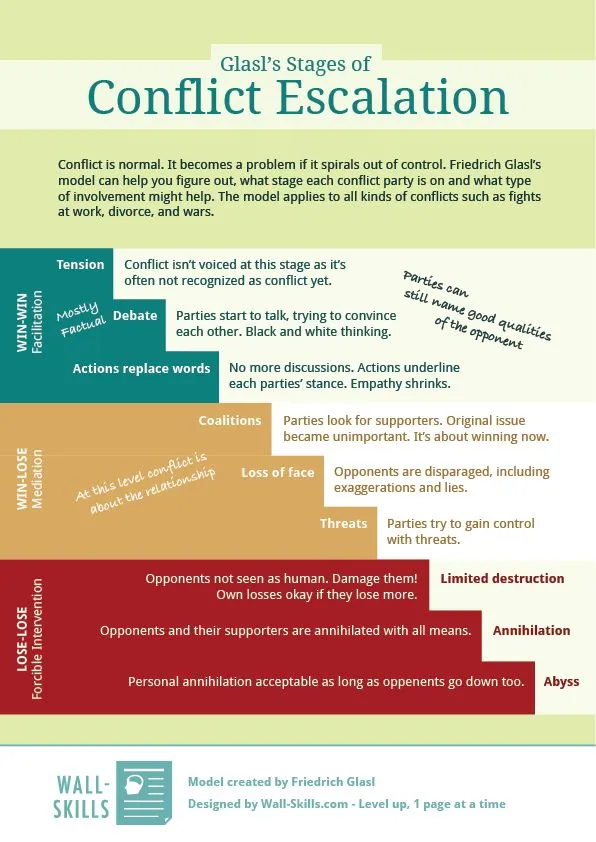
Stage 1: Tension – first signs of conflict
At the beginning, there are usually slight tensions and occasional friction. Different opinions arise, but are not yet perceived as conflict.
However, if positions harden and viewpoints become increasingly "fixed," what was initially a normal difference of opinion can develop into a serious conflict.
Typical signs:
- Irritable mood
- misunderstandings
- Initial discussions on recurring topics
Now is a good time to consciously seek dialogue and clear up misunderstandings.
Stage 2: Polemics – the conflict becomes personal
In this phase, the conflict intensifies noticeably. Each party is convinced that they are right.
Arguments are no longer exchanged to create understanding, but to convince—or outdo—the other party.
Thinking becomes polarized: black or white, right or wrong. The ability to listen diminishes, while the desire to impose one's own point of view grows.
Warning signs:
- Frequent heated discussions
- Strong fixation on one's own opinion
- Decreasing willingness to listen to others
Stage 3: Actions – Deeds instead of words
From the third stage onwards, the conflict shifts from communication to action.
Conversations are broken off, signals from the other party are ignored or deliberately overlooked.
Both sides try to establish facts – often without consideration for feelings or consequences.
Typical patterns:
- refusal to talk
- Entrenched positions
- Increasing emotional stress
- "Enough is enough" mentality
At this point, it is difficult to resolve the conflict without external assistance.
Why early conflict resolution is crucial
According to Glasl, the first three stages are considered a "win-win area": the parties can still find solutions without harming each other.
However, the more the conflict escalates, the more difficult it becomes to find a way out without professional support.
From stage 3 onwards, it is strongly advisable to bring in a neutral and professional third party—such asa mediatoror conflict counselor—to help defuse the situation and open up new avenues of communication.
Conclusion: Identify conflicts early on – enable solutions
Understanding the first three stages of the Glasl model helps to identify conflicts early on and take conscious steps to counteract them. By taking tensions seriously, communicating mindfully, and seeking support in good time, you can prevent escalations and strengthen long-term stable relationships—both professionally and privately.